Effective HVAC Advertising Strategies for Success
It's the hottest week of the year, and your air conditioner is making a strange rattling noise before sputtering into silence. You pull out your phone, and the search results are a dizzying blur of promises: "$49 Emergency Service!" and "AC Tune-Up Special!" flash next to offers for "$5,000 Off a New System!" They all sound helpful, but which one can you actually trust when your home is turning into an oven?
This is the minefield of HVAC advertising, and its first rule is that an ad's main purpose is often just to get a company's foot in your door. In practice, that eye-catching low price on a service call is what the industry calls a "loss leader"—an offer designed to lead to a much larger sale once a technician is in your home. These tactics are intentionally confusing and prey on the urgency of a broken system.
If you feel overwhelmed and unsure who to believe, you are not alone. Separating a legitimate maintenance deal from a bait-and-switch tactic is a skill most homeowners are never taught. The world of marketing for heating and cooling companies has its own language, and a simple-looking ad for a tune-up can quickly turn into a high-pressure pitch for a brand-new, expensive system you might not even need.
This guide gives you the tools to see past the hype, breaking down exactly what those flashy ads mean and how to spot the red flags of a misleading offer. You will learn the critical questions you must ask before ever letting a technician start work. By the end, you'll be able to navigate your next HVAC need not with anxiety, but with the confidence of an empowered and informed consumer.
The Truth Behind the "$49 Tune-Up" Special
You've seen the ads in your mailbox or social media feed: "Pre-Season AC Tune-Up for Just $49!" It sounds like a fantastic deal, especially when you know a system failure could cost thousands. These offers are a staple of hvac seasonal advertising campaigns for one simple reason: they work. But what they work at might not be what you think.
That ultra-low price is a classic business tactic known as a loss leader. The company isn't making money on the $49 service—in fact, they are likely losing money after paying for the technician's time and travel. The real goal is to get a trained salesperson (disguised as a technician) inside your home. For HVAC businesses, this is one of the most effective hvac lead generation ideas because it provides a golden opportunity to sell you something much more expensive.
This is where the upsell comes in. The tune-up gives the technician a chance to "discover" a serious problem that requires an immediate, costly repair or, more often, a complete system replacement. While some issues found during maintenance are legitimate, a visit based on a loss-leader ad can put you on the defensive.
To protect yourself, watch for these red flags during a low-cost service call:
- The Urgent Crisis: The technician immediately finds a "dangerous" or "catastrophic" problem (like a cracked heat exchanger or a failing compressor) that requires a brand-new system.
- High-Pressure Pitches: You're told the special price on a new unit is "only good for today," creating a false sense of urgency.
- Vague Explanations: The technician uses confusing technical jargon to describe the issue and can't clearly explain why a part is failing or show you the physical evidence.
Your best defense is to be direct. When the technician arrives, politely state, "I'm interested in the tune-up service advertised, but I'm not looking to discuss a new system right now." This sets a clear boundary. So, if a $49 special is often just a sales tool, what should you expect to pay for a legitimate service call?
What Should a Real HVAC Service Call Cost?
While prices vary by region, you'll find that most reputable HVAC companies charge a diagnostic fee or trip charge ranging from $90 to $150. This initial fee is for the diagnosis, not the repair itself. Seeing this higher number shouldn't scare you off; in fact, it's often a sign that you're dealing with a company that values its expertise and isn't relying on a bait-and-switch. The fee covers the initial investment of getting a qualified professional to your door.
That charge ensures the company can cover its essential operational costs, which are there to protect you. Think of it as paying for a safety net. This fee helps pay for a trained and certified technician's salary, comprehensive insurance in case something goes wrong, a work vehicle stocked with thousands of dollars in parts, and ongoing training. The foundational marketing for heating and cooling companies that operate this way focuses on reliability, not just rock-bottom prices. You're paying for a professional to accurately identify the problem, not just a salesperson to get in the door.
Before you book any service, your first question should be, "What is your diagnostic fee, and what does it include?" A transparent company will answer clearly, explaining that the fee covers the technician's time and travel to diagnose the issue within their hvac service area targeting. Most will also tell you that if you approve the repair they quote, they will apply that initial fee toward the final bill. This simple question helps you screen for honest businesses and sets the stage for a professional repair. But what happens when the problem isn't a small repair, and you start seeing ads for entirely new systems?
Deconstructing the "Free Furnace with AC Purchase" Deal
When your HVAC system is on its last legs, few offers are as tempting as getting a major component for free. Ads proclaiming "Buy an Air Conditioner, Get a Furnace FREE!" are some of the most common and seemingly effective hvac ad copy examples you'll encounter. They promise immense value and appear to solve two problems at once. But as with any deal that sounds too good to be true, it's essential to understand the math behind the marketing. How can a company afford to give away a piece of equipment worth thousands of dollars?
The short answer is, they can't. This type of offer is a classic example of bundled pricing. Think of it like a combo meal at a fast-food restaurant; you aren't getting free fries, their cost is simply included in the total price. In HVAC, the cost of the "free" furnace is absorbed into the price of the air conditioner and the installation labor. This isn't necessarily dishonest, but it does make it impossible to know the true cost of each component, which is a key strategy for hvac advertising that works by simplifying the perceived value.
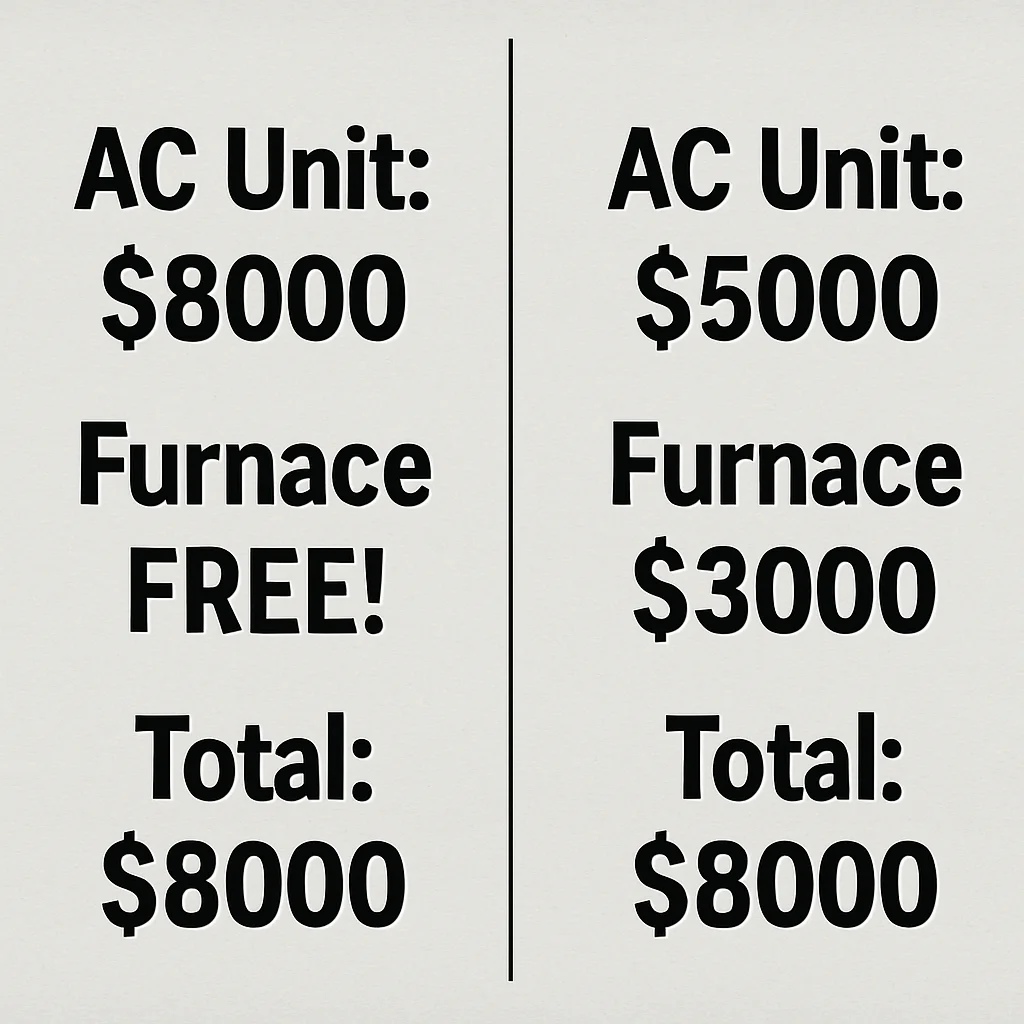
To see the real numbers, you need to ask for an itemized quote. This is a detailed breakdown that lists the price for each piece of equipment and the cost of labor separately. Instead of one lump sum, you'll see exactly what you're paying for the air conditioner, the furnace, and the work to install them. A bundled offer for an "$8,000 AC with a free furnace" might suddenly look very different when itemized as a "$5,000 AC unit + a $3,000 furnace unit," revealing that nothing was ever truly free.
Here's a simple action you can take to test any bundled deal: call another reputable company and ask for a quote on only the main component (the air conditioner, in this case). If their price for the AC alone is significantly lower than the bundled price you were quoted, you'll know the "free" item's cost was just hidden. The best hvac ad copy examples for consumers are those that offer transparency, not just a flashy headline. Of course, sometimes the total price isn't the focus at all. Instead, the ad highlights a very different number.
What Does "$99/Month for a New HVAC System" Really Mean?
That low monthly payment ad can seem like a lifesaver, especially when you're facing a multi-thousand-dollar replacement. But it's crucial to understand what you're really looking at: not a price tag, but a loan offer. This kind of hvac advertising that works is highly effective because it shifts your focus away from the intimidating total cost and onto a manageable monthly number. Think of it like a car payment. You wouldn't say your car costs $300; you'd say it costs $25,000, and your payment is $300 per month. The same logic applies here. The ad isn't for a $99 system; it's for a financing plan that lets you pay for a much more expensive system over time.
The catch is that "over time" almost always includes interest. A low monthly payment stretched over many years can hide a shockingly high total price. Before you get drawn in by the easy monthly number, do this simple math: multiply the monthly payment by the number of months in the loan term. For example, a $99/month offer for a 10-year term (120 months) means you're actually paying $11,880 for that system. The difference between this total and the system's cash price is the interest you're paying for the convenience of financing, often expressed as an Annual Percentage Rate (APR).
To protect yourself, always ask for three key numbers before agreeing to any financing deal: the cash price if you paid upfront, the monthly payment, and the total number of payments. This allows you to calculate the true cost and see exactly how much you're paying in interest. A company with a high hvac marketing budget breakdown might push financing hard, but getting these figures puts you back in control. Once you know the real price of each quote, you can start to compare what you're actually getting for your money.
How to Compare Quotes: Understanding SEER and AFUE Ratings
Once you've cut through the financing offers and have the real, total price for a new system, the next logical question is, "What am I actually getting for my money?" Two identical-looking outdoor units could have vastly different price tags and performance. The secret to telling them apart lies in understanding their efficiency ratings—two little acronyms that have a huge impact on your monthly utility bills.
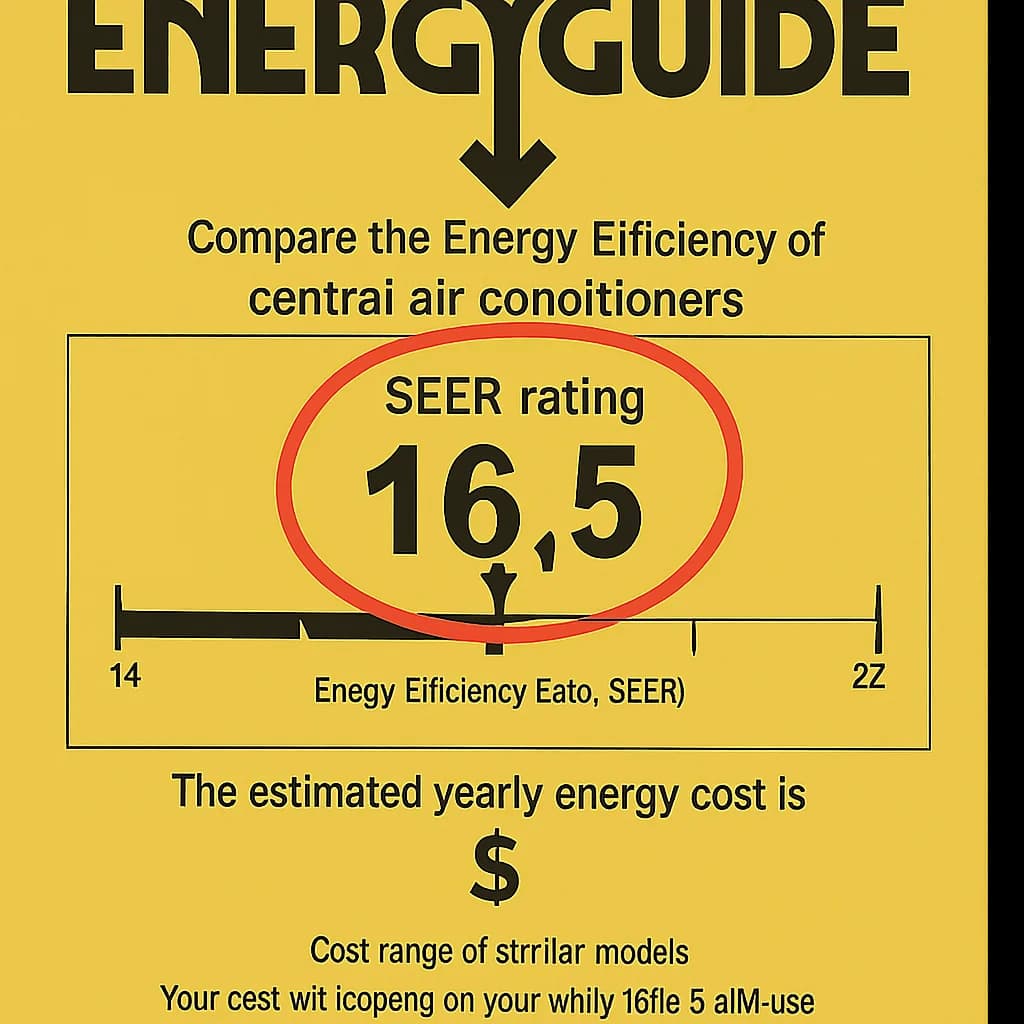
First up is the air conditioner's report card: the SEER rating. SEER stands for Seasonal Energy Efficiency Ratio, but you can just think of it as your AC's version of a car's MPG (miles per gallon). The higher the SEER number, the less electricity the unit sips to cool your home. For example, a 16 SEER unit is significantly more efficient than a 13 SEER unit, which means lower summer electric bills for you. You can usually find this number on the yellow "EnergyGuide" sticker on the side of a unit, a detail that many hvac digital marketing strategies conveniently leave out of their ads.
For your furnace, the key metric is AFUE, or Annual Fuel Utilization Efficiency. This one is even simpler to understand because it's a percentage. An 80 AFUE furnace converts 80% of its fuel (like natural gas or oil) into heat for your home, with the other 20% being lost as exhaust. A 95 AFUE furnace, on the other hand, wastes only 5%. That 15% difference means more of every dollar you spend on heating stays in your house.
So, when you have several quotes laid out on your kitchen table, here's how to make a true apples-to-apples comparison. Ignore the brand names for a moment and focus on these three things for each quote: the SEER rating of the AC, the AFUE rating of the furnace, and the total installed price. This simple process cuts through the noise of hvac advertising that works by focusing on performance and long-term cost, not just a flashy logo. But efficiency isn't the whole story; you also need to ensure the system is the right size for your home.
Why Bigger Isn't Better: The Importance of "Right-Sizing" Your System
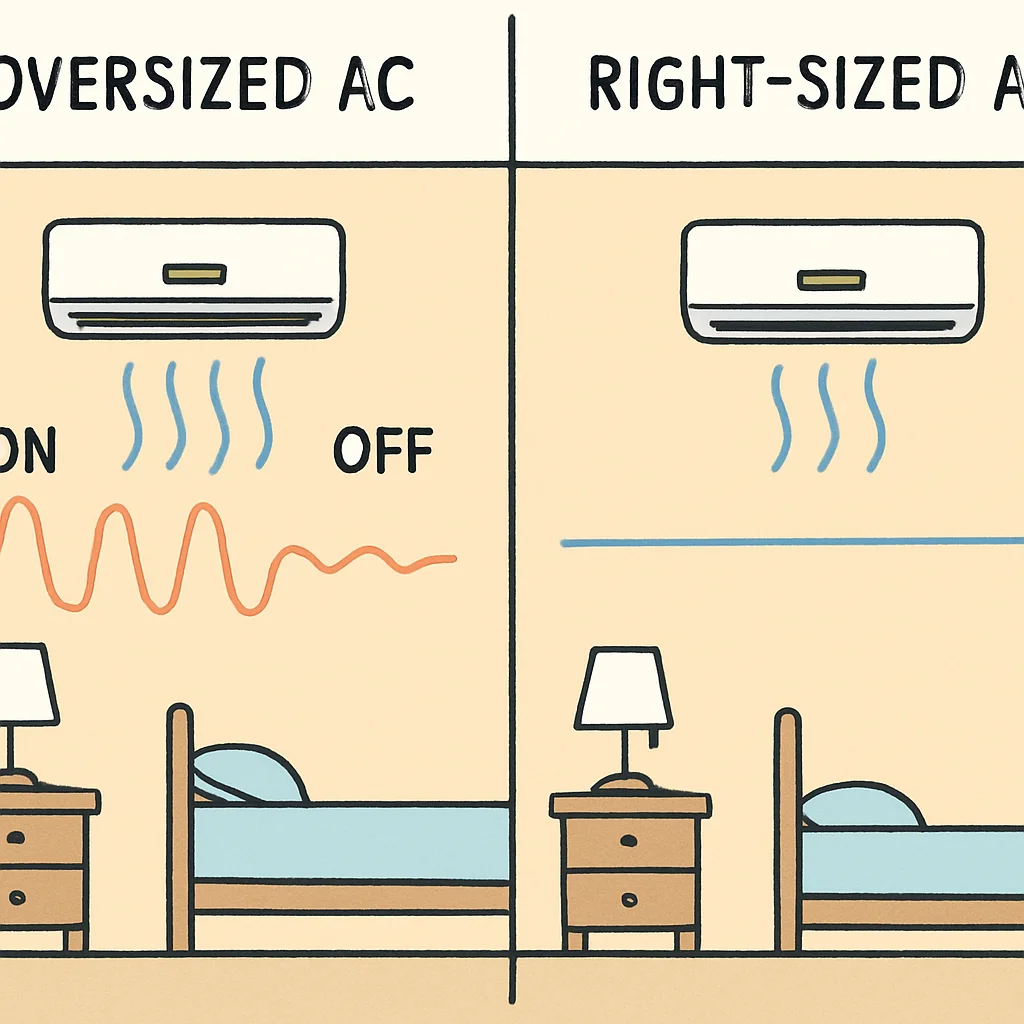
It seems logical that a bigger, more powerful air conditioner would cool your house faster and better. But in the world of HVAC, "bigger" is almost always a mistake. An oversized system is like a drag racer in city traffic—it blasts on at full power, reaches the target temperature in a flash, and then slams off. This constant on-and-off jarring is called "short-cycling." Not only does it cause huge temperature swings and high energy bills, but it also fails to run long enough to remove humidity from the air, leaving your home feeling cool but unpleasantly clammy. This excessive wear and tear also means you'll likely face expensive repairs and a shorter lifespan for your new unit.
So, how does a professional contractor find the "just right" size? They don't guess or use a vague rule of thumb. Instead, they perform a detailed analysis called a "Manual J load calculation." This is the industry standard for determining exactly how much heating and cooling your specific home needs. The calculation accounts for everything: your home's square footage, the number and quality of your windows, insulation levels, local climate, and even the direction your front door faces. Some contractors skip this crucial step to save time, applying a one-size-fits-all guess across their entire hvac service area targeting, which is a major disservice to the homeowner.
This brings us to a simple but powerful question you must ask any company giving you a quote: "Did you perform a Manual J load calculation, and can I see the report?" A reputable contractor will be proud to show you their work. If they hesitate, give you an excuse, or admit they just "know" the right size based on experience, that's a giant red flag. Answering this question correctly is a key part of effective hvac advertising that focuses on homeowner value, not just quick sales. Demanding this calculation helps you filter out the guessers and get more hvac service calls from true professionals. Knowing what to ask is the first step; the next is knowing where to find contractors you can trust.
Finding Trustworthy Contractors: Decoding Google's "Guaranteed" Badge
Knowing what to ask is half the battle; knowing where to look is the other. When your HVAC system fails, your first instinct is probably to search on Google. You'll be met with a wall of results, but the most valuable ones are often sitting right at the very top—and they look a little different from the rest. These aren't your typical search results or standard ads; they are a special type of listing designed to give you more confidence when hiring a local pro.
You've likely seen them: a row of boxes at the top of the page with company names, review ratings, and a small green checkmark labeled "Google Guaranteed." These are part of a program called Local Service Ads for HVAC contractors. To earn that badge, a business can't just pay for it. They must pass a background check and provide Google with proof of their licenses and insurance. It's a first-level screening process done for you before you even make a call.
The "Guaranteed" badge offers more than just peace of mind; it provides a real safety net. If you book a job through one of these specific ads and are not satisfied with the quality of the work, Google may refund you the amount you paid for the service, up to a lifetime limit of $2,000. This protection is a significant step up from standard Google ads for HVAC services, which don't carry the same backing. It fundamentally changes how to advertise an HVAC business, incentivizing contractors to prioritize verifiable credentials and customer satisfaction.
So, when you find yourself in an urgent situation, make those "Google Guaranteed" profiles your first clicks. While this guarantee doesn't replace the need to do your own homework, it provides a powerful filter that weeds out unvetted or potentially uninsured operators. It's an excellent starting point, but once a technician is on their way, you still need to be prepared.
Your 5-Point Checklist Before You Hire an HVAC Company
An HVAC ad that was once a mystery box of potential savings or hidden costs is now a puzzle you can solve. You can see behind the curtain, knowing that the most effective hvac lead generation is designed to get a foot in the door, and you have the tools to distinguish a genuine offer from a high-pressure sales tactic. You're no longer just hoping for an honest contractor; you are equipped to verify one.
With this knowledge, you are ready to take control of the conversation. Treat your next quote as an interview where you are the hiring manager. To ensure you get the right value, not just the lowest price, have this checklist ready. Ask every potential contractor these five questions:
- Are you licensed and insured in my state?
- Will you provide a detailed, itemized quote in writing?
- How did you determine the size of the system I need? (Listen for "Manual J calculation.")
- What are the SEER and AFUE ratings of the proposed equipment?
- What are the full warranty terms for parts, labor, and the compressor?
From now on, you won't see an ad as a gamble but as the start of a screening process. The right questions are your shield and your guide, ensuring that the only HVAC advertising that works is the kind that leads to a fair deal for you. You're not just buying a piece of equipment; you're investing in your home's comfort with confidence.